
Google Says AI Search Is Sending Better Traffic. Cool. Define Better.

Google would like everyone to know that AI-powered search is doing just fine, thank you very much.
Actually, better than fine.
According to Google, AI Overviews and AI Mode are driving more searches, organic clicks to websites are holding relatively steady, and the clicks people do make are supposedly higher quality.
Which sounds lovely.
Except there's one tiny little problem.
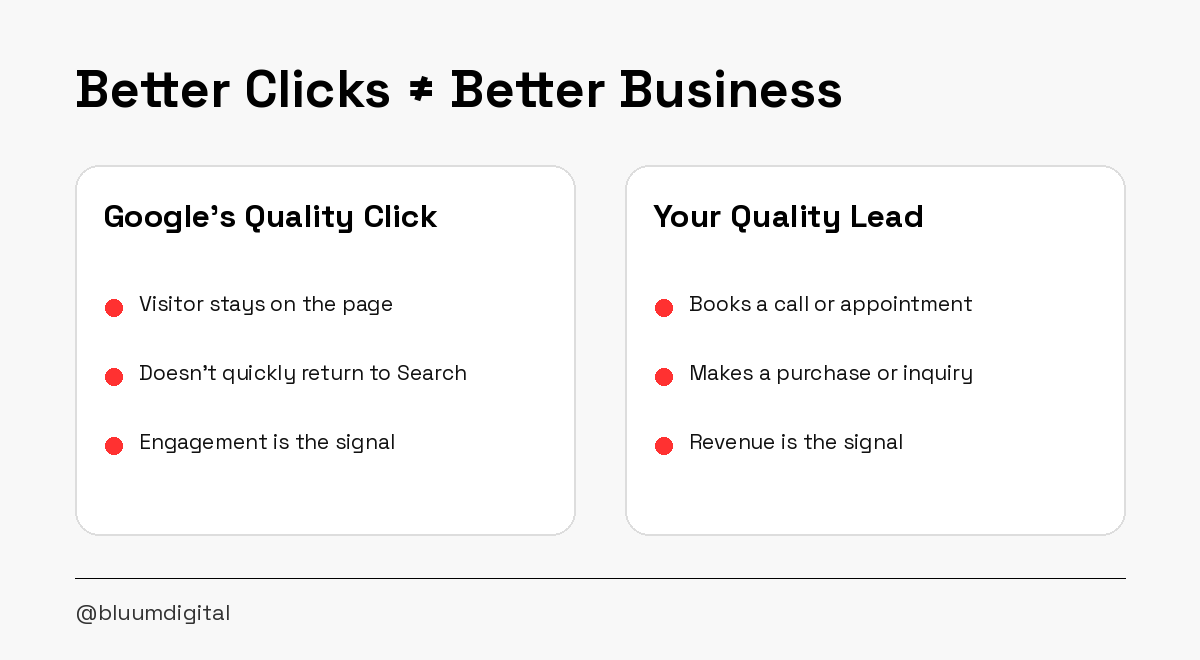
Google's definition of a quality click and a business owner's definition of a quality lead are not remotely the same thing.
And before we start celebrating the future of search, I think we need to talk about that.
TLDR;
Google says AI Search is sending higher-quality traffic. According to Google, organic clicks are holding relatively steady, and visitors are more engaged when they reach a website.
More engagement doesn't automatically mean more customers. Someone spending five minutes on your website is great, but it doesn't mean much if they're not taking action.
Zero-click searches are still a very real concern. AI Overviews can answer questions directly in search results, meaning users don't always need to visit a website.
Businesses need to measure more than traffic. Rankings, impressions, and clicks are only part of the picture. Qualified leads, conversions, and revenue are what actually tell us whether SEO is working.
So, What Did Google Actually Say?
On August 6, 2025, Google's Head of Search, Liz Reid, published an update addressing concerns about AI Search and declining website traffic.
The big claims were that total organic click volume remained relatively stable year over year, average click quality had increased, and AI-powered search was creating new opportunities for websites to be discovered.
Google also acknowledged that traffic isn't being distributed equally. Some websites are gaining visibility while others are losing it.
That last part is doing a lot of heavy lifting.
Because saying Google sends roughly the same number of clicks to the internet doesn't mean your business is receiving the same number of clicks it did last year.
Apparently, Not Clicking Back Means You're a Quality Visitor
Here's where things get interesting.
Google defines a quality click as one where the visitor doesn't immediately return to the search results.
And sure, that's a reasonable engagement signal.
But engagement isn't revenue.
Someone can spend six minutes reading your blog, learn absolutely everything they wanted to know, and never contact your business.
Meanwhile, someone else can land on your website, immediately find your phone number, call you, and become a customer.
Guess which one I'd rather have?
A longer visit isn't automatically a better visit.
It might indicate interest. It might indicate confusion. It might mean someone left the tab open while making a sandwich.
Without connecting that behavior to actual business outcomes, we're making assumptions.
And assumptions are a pretty expensive marketing strategy.
The Zero-Click Problem Isn't Going Away
Let's give Google some credit where it's due.
AI-powered search genuinely changes how people find information. More complex questions, more conversational searches, and more context before someone reaches a website can create opportunities for businesses.
But there's another side to that.
If Google answers someone's question directly in an AI Overview, they might not need to visit the source website at all.
That's not a hypothetical concern.
A July 2025 Pew Research Center analysis found that users were less likely to click traditional search results when an AI summary appeared. Google disputed the broader conclusions drawn from third-party research, but its own August statement acknowledged that some questions are answered without a further click.
And this is where I think the conversation gets a little ridiculous.
We're being asked to believe that fewer clicks might be perfectly fine because the remaining clicks are better.
Okay.
Show me the conversions.
Your SEO Strategy Needs to Go Beyond Traffic
If you're a business owner, I don't think the answer is to panic and abandon SEO.
I also don't think the answer is to blindly accept Google's reassurance that everything is peachy.
The answer is to get much more intentional about what you're measuring.
Start by looking at whether organic traffic is generating meaningful actions: qualified inquiries, booked appointments, phone calls, purchases, and ultimately revenue.
Then look at which pages are driving those actions.
A service page that brings in 100 highly relevant visitors and generates 12 inquiries might be substantially more valuable than a blog post bringing in 5,000 visitors who never take another step. Those are illustrative numbers, not client results.
And if impressions are increasing while clicks are declining, don't automatically assume your SEO is failing. Look at the queries, the pages involved, and whether the search results themselves are answering questions that previously required a website visit.
Google Search Console can help you understand changes in visibility and clicks. Your analytics and CRM should help you understand what happens afterward.
Neither one tells the complete story by itself.
What Should Businesses Actually Do About AI Search?
First, keep creating content that's genuinely useful.
Not 800 words of recycled information that could've been written by literally anyone with access to ChatGPT.
I'm talking about original perspectives, real experience, specific examples, and answers that demonstrate you actually know what you're talking about.
Google's own May 2025 guidance encouraged unique, valuable content and emphasized measuring the full value of search visits rather than focusing exclusively on click counts.
Second, make sure your website gives people a reason to take the next step.
If someone lands on your page after researching a service, can they immediately understand what you offer, who it's for, and how to get started?
Or are they being greeted by a vague headline about innovative solutions and a contact form buried somewhere in the footer?
Third, stop treating rankings as the finish line.
Visibility matters. Traffic matters.
But neither pays the bills without a path to conversion.
Our Final Take: Better Traffic Is Only Better If It Actually Does Something
I'm not anti-AI Search.
I think the way people search is changing, and I think businesses that adapt their content, measurement, and conversion strategies will have opportunities to benefit.
But I'm also not interested in pretending every change Google makes is automatically good for advertisers, publishers, or business owners.
Google says the clicks are getting better.
Great.
Now let's see whether they're turning into better business.
Because until we can connect those clicks to actual outcomes, higher quality traffic is just a really nice phrase for a presentation deck.
And we've got enough of those.
If your organic traffic reports look great but you're still wondering where the actual customers are, that's probably worth a conversation. Bluum can help you figure out what's working, what's not, and what needs to change.


Comments