
Your Cost Per Lead Looks Amazing. So Why Aren't You Making Any Money?

Your Google Ads dashboard is glowing green. Cost per lead is down. Conversions are up. Your marketing team is celebrating.
So why does your sales team look like they've been personally victimized by every lead that comes through the door?
Because somewhere along the way, we decided that getting someone to fill out a form was the same thing as getting a customer. And, respectfully, it's not.
A cheap lead isn't automatically a good lead. A low cost per lead isn't automatically a profitable campaign. And a dashboard full of conversions doesn't mean much if none of those people are actually buying anything.
Let's talk about why.
TLDR;
A lower cost per lead doesn't necessarily mean better performance. If those leads aren't qualified or converting into customers, you're just paying less for more work.
Your ad platform doesn't know which leads are actually valuable unless you tell it. Optimizing for form submissions alone can reward quantity over quality.
The cheapest campaign can end up being the most expensive. Lead-to-customer conversion rates and customer acquisition costs tell a much more useful story than CPL alone.
Your marketing and sales data need to talk to each other. Connecting qualified leads and actual sales outcomes back to your campaigns is how you make smarter budget decisions.
The Cheapest Lead Isn't Always the Best Lead
Let's say you're running two Google Ads campaigns. Campaign A is bringing in leads for $15 each. Campaign B is bringing them in for $60. On paper, Campaign A looks like the obvious winner.
Why would you pay four times as much for a lead when you could get one for $15? Well, because a lead isn't a customer.
Here's what happens when we follow those leads a little further down the funnel.
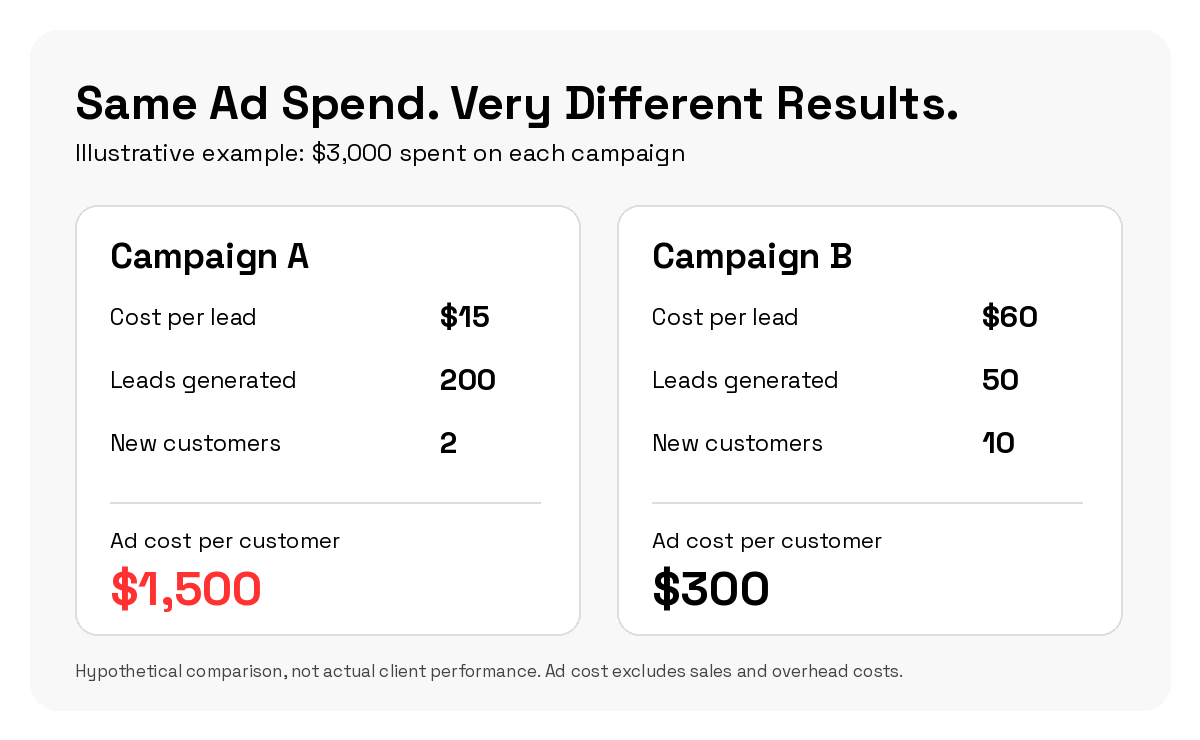
Same advertising budget. Wildly different results. Campaign A delivered four times as many leads per dollar. Campaign B delivered five times as many customers.
And if we're only looking at cost per lead, we'd probably be pouring more money into the wrong campaign.
This is exactly why I get nervous when an agency's entire performance report revolves around how many leads they generated. It's not that CPL doesn't matter. It absolutely does. It just doesn't get to be the only thing that matters.
Your Ad Platform Is Optimizing for Exactly What You Told It To
Here's the part that gets overlooked. Google Ads and Meta Ads are incredibly sophisticated platforms. They can process an absurd amount of data and make bidding decisions faster than any human ever could. But they're not mind readers.
If you tell Google that every form submission is a valuable conversion, you're teaching the system to find more people who submit forms. Not necessarily people who can afford your services. Not necessarily people in your service area. Not necessarily people who are actually interested in becoming customers. Just people who fill out forms.
And if you're counting things like page views, button clicks, or other low-intent actions as primary conversions, the problem can get even worse. Because now your campaign might be celebrating someone clicking a button like they just signed a six-figure contract.
Google distinguishes primary and secondary conversion actions, which matters when deciding what your bidding strategy should optimize toward. Google Ads conversion goals documentation
Google has also supported enhanced conversions for leads to help connect later sales outcomes with earlier ad interactions. Google Ads enhanced conversions for leads documentation
The technology exists. The question is whether you're actually using it.
Your Sales Team Probably Knows Something Your Dashboard Doesn't
Want to know who usually has the best insight into lead quality? The people actually talking to the leads.
Your sales team knows when inquiries are coming from people who don't understand your pricing. They know when prospects are outside your service area. They know when half the form submissions are unreachable. They know when someone books a consultation and then immediately disappears. And they definitely know when the leads are good.
But that information often lives in a CRM, spreadsheet, inbox, or someone's head instead of making its way back to the marketing platform.
So marketing keeps optimizing for more leads. Sales keeps complaining about the leads. And everyone spends the next monthly meeting trying to figure out why the numbers don't match.
Fun little cycle we've created for ourselves, isn't it?
The fix isn't necessarily more leads. It's creating a feedback loop between the people generating the leads and the people responsible for turning them into customers.
Stop Asking What a Lead Costs. Start Asking What a Customer Costs.
Cost per lead (CPL) tells you how much you're paying to generate an inquiry. Lead qualification rate tells you what percentage of those inquiries are actually worth pursuing. Lead-to-customer conversion rate tells you how many inquiries turn into paying customers.
Customer acquisition cost (CAC) tells you how much it costs to acquire a customer. For a full business-level CAC, that means accounting for relevant marketing and sales costs, not just ad spend. Customer value helps you understand whether acquiring that customer was profitable in the first place.
Because a $300 customer acquisition cost might be fantastic for a business selling a $10,000 service. And absolutely terrible for a business selling a $75 product. Context matters. A lot.
What Should Businesses Actually Do Differently?
First, audit what your campaigns are counting as conversions. If you're optimizing for every form submission, that's not necessarily wrong. But you should understand what percentage of those submissions become qualified opportunities and customers.
Second, make sure you're collecting enough information to assess lead quality without turning your form into a 47-question interrogation.
Third, establish consistent qualification criteria. A qualified lead should mean something specific to your business, not just someone who gave you a real email address.
Fourth, connect your CRM and sales outcomes back to your advertising data wherever it's technically and legally appropriate.
And finally, give your campaigns enough meaningful conversion data to learn from. Not every business generates enough closed sales for a bidding strategy to optimize directly toward customers. Sometimes a qualified lead or booked appointment is the more practical optimization event.
The point isn't to jump straight to the deepest possible conversion. It's to move toward the deepest reliable, sufficiently frequent, and meaningful conversion you can measure.
Our Final Take: Cheap Leads Don't Pay the Bills
I'm not saying you should stop caring about cost per lead. I'm saying you should stop treating it like the final score.
A campaign that generates 200 leads might be doing an incredible job. Or it might be generating 200 opportunities for your sales team to question their career choices.
You won't know until you look beyond the form submission.
At Bluum, we're much more interested in what happens after someone converts than simply celebrating that they converted in the first place. Because the goal isn't to win the cheapest-lead competition. It's to grow a business. And those are two very different things.
If your ad reports look amazing but your revenue isn't getting the memo, let's talk about what's happening between the click and the customer. Explore Bluum Digital


Comments