
Your Website Isn't Just Competing With Other Websites Anymore. It's Competing With Google.

Remember when the goal of SEO was pretty straightforward? Get your website to show up on Google, convince someone to click, and hopefully turn that visitor into a customer.
Cute. Simpler times.
Now Google is answering questions, summarizing information, recommending next steps, and increasingly helping people complete tasks without ever needing to visit the websites that supplied the information in the first place.
And as of yesterday, August 21, Google announced that AI Mode was expanding to more than 180 additional countries and territories.
So, if your entire SEO strategy is built around answering questions that Google can now answer itself, we should probably talk.
Because getting found and getting chosen are becoming two very different things.
TLDR;
Google is becoming part of the customer journey, not just the starting point. AI Overviews and AI Mode can help people research businesses without visiting every website along the way.
Generic informational content has a tougher job. If your page offers the same basic explanation as everyone else's, there's less reason for someone to click through.
Original expertise and real proof matter. Case studies, examples, experience, and specific insights give people something an AI-generated summary can't fully replace.
Your website still needs to convert. Visibility is valuable, but clear service pages, compelling offers, and an easy next step are what help turn interest into business.
Google Isn't Just Sending Traffic Anymore. It's Answering the Questions.
For years, Google was essentially the middleman. Someone searched for something. Google showed them a list of websites. They clicked around until they found what they needed.
Now, the experience is changing. With AI Overviews and AI Mode, Google can pull together information from multiple sources and present an answer directly within Search.
And on August 21, 2025, Google announced an expansion of AI Mode into more than 180 additional countries and territories, along with new agentic capabilities for certain tasks.
Google's August 21 announcement: Read Google's announcement
Which means Google's ambitions extend beyond helping people find information. It's increasingly trying to help them do something with that information.
That's convenient for users. For businesses that rely on organic traffic? It's a little more complicated.
Because when Google can answer someone's question before they click, your website needs to offer something beyond the answer.
Your 1,500-Word Blog Post Explaining the Obvious Isn't a Competitive Advantage
I'm going to say something that might upset a few content marketers. Not every question needs a blog post. And not every blog post deserves to exist just because a keyword research tool says 2,400 people search for something every month.
For a long time, SEO strategies leaned heavily on creating informational content around every possible variation of a question.
What is PPC? How does SEO work? What are the benefits of digital marketing? You know the ones.
And while educational content absolutely still has a place, a generic explanation that sounds exactly like the other 47 articles on page one isn't giving people much of a reason to choose your website. Especially when Google can summarize the answer in seconds.
This doesn't mean informational content is dead. It means information alone isn't much of a differentiator.
The opportunity is in what you can add to that information. Your experience. Your perspective. Your data. Your actual understanding of the problems your customers are trying to solve.
Because explaining what something is and demonstrating that you know how to make it work are two very different things.
The Stuff AI Can't Easily Replicate Is the Stuff You Should Be Publishing
Think about the difference between these two articles. One is titled 5 Benefits of Google Ads for Small Businesses. The other breaks down how a local service business improved lead quality after discovering that its campaigns were optimizing toward the wrong conversion actions.
The first explains something. The second demonstrates expertise.
And if I'm a business owner trying to figure out whether an agency knows what it's doing, I know which one I'm more interested in reading.
This is where businesses have an opportunity to differentiate themselves.
Publish actual case studies, not just vague claims about delivering incredible results. Show your work. Explain your thinking. Share what didn't work and what changed.
Include original photography, examples, comparisons, and insights that come from doing the work rather than rewriting what everyone else already said.
None of this guarantees that Google will send you traffic or feature your content in AI-generated answers. But it gives your website something worth visiting. And that's the point.
Your Service Pages Might Be More Important Than Your Next 20 Blog Posts
Here's another thing I'd like businesses to reconsider. If you're spending thousands of dollars creating blog content but your actual service pages are three paragraphs of generic copy and a contact form, your priorities might be a little backward.
Imagine someone has already researched their options. They understand the problem. They know the type of service they need. Now they're trying to decide who to hire.
At that point, they probably don't need another article explaining the definition of your service. They need to know whether you're the right business for them.
Your service pages should answer the questions that actually influence a buying decision. Who is this service for? What problems does it solve? How does your process work? What makes your approach different? What results can someone reasonably expect? And what happens when they reach out?
This is where testimonials, case studies, FAQs, pricing context, and clear calls to action become especially valuable.
Not because Google has suddenly stopped caring about blogs. But because the purpose of your website isn't just to attract visitors. It's to help the right visitors make a decision.
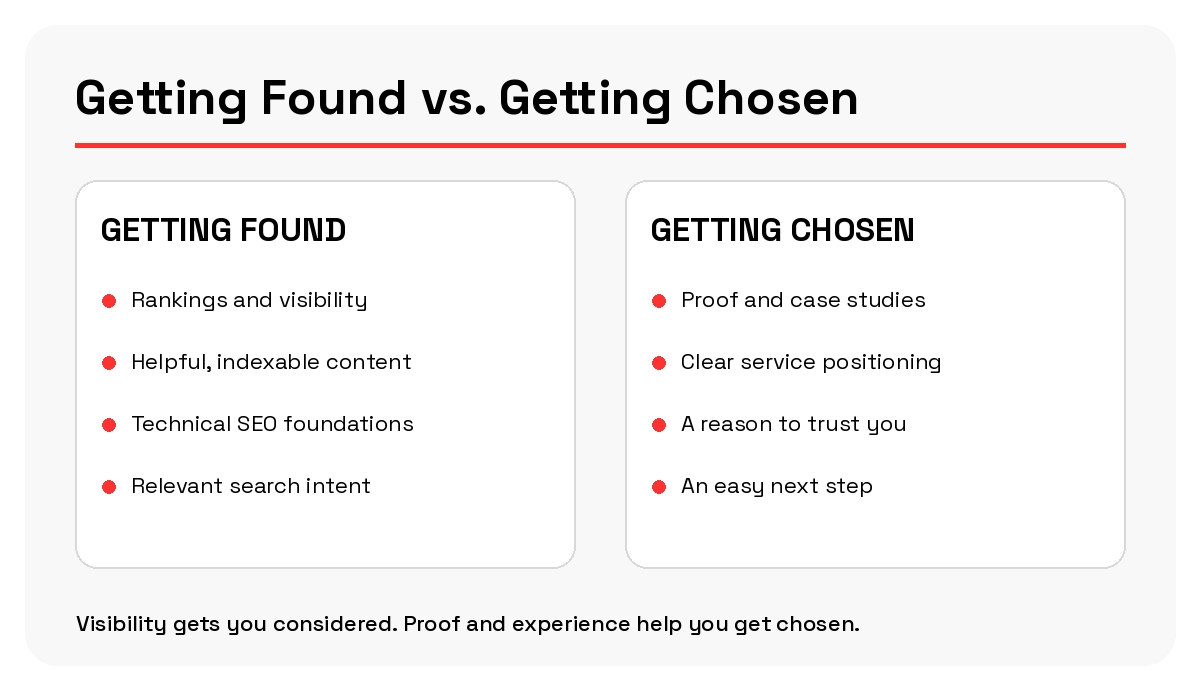
Five Things I'd Prioritize Before Publishing Another Generic Blog Post
Make your expertise obvious. Replace vague claims with specific examples, processes, and firsthand insights.
Give people proof. Add case studies, testimonials, meaningful results, and examples of your actual work.
Strengthen your service pages. Answer buying questions, not just informational questions.
Make the next step ridiculously easy. Clear CTAs, simple forms, and a conversion path that makes sense.
Don't neglect technical SEO. Your pages still need to be accessible, indexable, fast enough to use comfortably, and understandable to search engines.
And before someone interprets this as permission to abandon SEO entirely, absolutely not.
Google's own guidance on succeeding in AI-powered Search still emphasizes unique, valuable content, a good page experience, and technical fundamentals. Read Google Search Central's guidance
The fundamentals aren't disappearing. But the way businesses apply them needs to evolve.
Stop Measuring Your Entire SEO Strategy in Clicks
Traffic is useful. Rankings are useful. Impressions are useful. But none of those numbers, on their own, tell you whether your website is helping your business grow.
As search experiences change, businesses should also be paying attention to branded search demand, qualified inquiries, conversion rates, and the revenue opportunities associated with organic discovery.
And we need to be careful about interpreting changes in traffic. A drop in clicks doesn't automatically mean your SEO strategy is failing. An increase in impressions doesn't automatically mean it's succeeding. And appearing in an AI-generated answer doesn't automatically mean someone is going to become a customer.
The challenge is understanding how search visibility contributes to actual business outcomes, even when the path from discovery to conversion becomes less straightforward.
Our Final Take: Being the Answer Isn't the Same as Being the Choice
Google is getting very good at answering questions. Congratulations to Google.
But there's a difference between knowing what a service is and deciding who you trust to provide it. And that's where your website still has a job to do.
Give people something they can't get from a generic summary. Show them why you're different. Make it easy to understand what you offer, why it matters, and what they should do next.
Because the future of SEO isn't just about getting someone to your website. It's about making sure there's a damn good reason for them to choose you once they get there.
If your website is getting attention but not turning that attention into opportunities, let's talk about making it work harder for your business. Explore Bluum Digital


Comments